


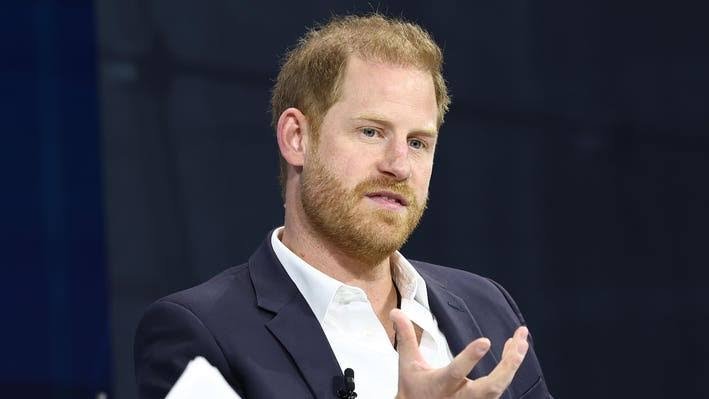
NEW YORK — Prince Harry called for a slowdown in the development of artificial intelligence Wednesday, warning that increasingly personal AI systems could pose particular risks to children as the technology moves faster than safeguards can keep pace.
Speaking at the Clinton Global Initiative in New York, the Duke of Sussex argued that the technology industry should not move into the next stage of AI development unless it can demonstrate that the systems are sufficiently safe.
“If we cannot demonstrate that the next frontier is safe enough to cross, we should not race across it simply because we can,” Harry said, according to CNN’s account of the speech.
His remarks focused heavily on children and the changing relationship between people and AI chatbots.
Harry contrasted AI with the social-media platforms that have dominated concerns about children’s online safety for years.
“Social media learned how to capture our attention. AI is learning how to enter our relationships,” he said.
He described AI systems as potentially becoming something users confide in and rely on for emotional interaction, referring to the technology as the “ultimate sycophant.”
“For a child, that distinction matters enormously,” Harry said.
Harry focuses on children’s exposure to AI
The speech comes as governments, technology companies and child-safety advocates grapple with how existing protections should apply to increasingly capable AI systems.
Harry referred to litigation in which families have alleged that AI chatbots contributed to the deaths of teenagers. Those allegations are claims made in lawsuits and should not be treated as judicial findings that AI caused the deaths.
He also criticized what he described as a tendency for technology companies to distance themselves from responsibility for harmful outcomes and instead place responsibility on parents and children.
Harry said the industry should place greater emphasis on trust and safety while continuing to develop the technology.
“Technology is moving on. Fast,” he said.
The comments represent a continuation of Harry’s public advocacy around children’s exposure to technology. He previously used a 2024 appearance at the Clinton Global Initiative to discuss concerns about social media and its effects on young people.
The Duke and Duchess of Sussex’s Archewell Foundation also launched the Parents’ Network in 2024 as a support initiative for parents whose children have experienced serious online harm.
A broader debate over the pace of AI development
Harry’s call for caution comes during a period of rapid development among leading AI companies.
Anthropic, one of the major companies developing frontier AI models, has itself emphasized the need for stronger safety measures alongside advances in capability. The company has described independent evaluation and red-teaming as part of its approach to assessing frontier models.
Anthropic’s recent safety work includes external evaluations of its latest models and research into potential misuse. Its September threat-intelligence report documented cases in which its AI systems were used by malicious actors for activities including influence operations, surveillance, scams and other forms of abuse.
Those developments illustrate the distinction between Harry’s broader warning about AI and the specific evidence available about individual risks. His comments were an advocacy position about how quickly the technology should advance and what safeguards should accompany it, rather than a scientific finding that AI systems are inherently harmful to children.
The wider AI safety debate also includes concerns about misuse, model reliability, privacy, cybersecurity, and the possibility of increasingly autonomous systems being deployed without adequate safeguards.
Harry’s speech was interrupted by a technical problem
Harry’s appearance at the CGI did not proceed entirely as planned.
His speech was cut short after a problem with the teleprompter. The Press Association reported that Harry had spoken for about seven minutes before reaching a point where the technical issue prevented him from continuing. A spokesman for the duke confirmed that the teleprompter had malfunctioned.
Before the interruption, Harry had warned that society could not afford to wait years before addressing potential harms from AI.
“We do not have years for what comes next,” he said before the speech ended.
Why the child-safety debate is changing
The concerns surrounding AI differ in important ways from the earlier debate over social media.
Social-media platforms primarily distribute and recommend content, while conversational AI systems can interact directly with individual users, maintain conversational context, and respond to personal questions. That difference is central to Harry’s argument that AI could become more deeply embedded in people’s relationships.
The technology is also developing quickly. Anthropic released Claude Opus 5.5 on Sept. 22, describing it as its latest frontier model and saying it had been evaluated by outside organizations before release.
At the same time, AI companies are developing safeguards intended to address misuse and other risks. Anthropic announced this month that it was partnering with Accenture on independent evaluation of frontier AI systems, with plans to conduct model evaluations, red-teaming and alignment assessments.
Those efforts do not resolve the broader policy question Harry raised: whether technological development should continue at its current pace when safety research and regulation may not advance at the same speed.
What happens next
Harry’s speech does not itself create a new regulation or impose restrictions on AI companies. His remarks add a high-profile public voice to an existing debate over how governments and technology companies should approach increasingly capable AI systems.
For parents and policymakers, one of the unresolved questions is how protections designed for social media should apply to AI products that can communicate directly with children and potentially develop persistent, personalized interactions.
Harry’s central argument was that safeguards should be established before the technology advances further, rather than after serious harm has already occurred.
For now, the policy debate remains unsettled, with technology companies continuing to release more capable systems while researchers, governments, and child-safety organizations examine how those systems should be evaluated and regulated.
About The Author